
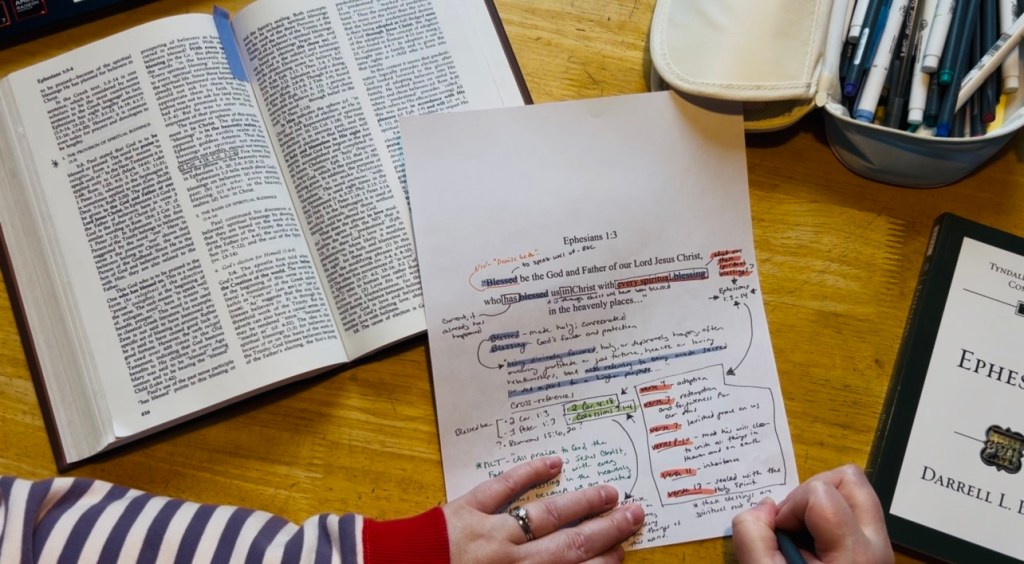
Why verse map?
1. Deepens your understanding of the text
Verse mapping is a great way to dig deeper into a verse that piques your interest. It’s also great if a verse feels hard to understand and you want to dig into deeper to gain a better understanding.
2. Slows you down
Verse mapping forces you to linger with a single verse instead of rushing through a passage. It helps you to see things you might miss if you are just rushing through.
3. Helps prevent misinterpretation
When we take the time to slow down and focus on a verse, IN ITS CONTEXT, (which I will share more about below) this helps us to interpret it correctly. When we just cherry pick verses out of scripture and out of context that is when misuse and misinterpretation can, and often do, happen.
4. Engages both heart and mind
Loving God with both our heart AND mind go hand in hand. When we use verse mapping we’re using our mind to study the text while allowing the Spirit to change our heart and mind through careful observation and reflection.
5. Good practice for digging into larger passages of scripture
The method for verse mapping I am sharing with you below can easily be used for digging into larger portions of scripture, beyond just one verse. Practice this method on one verse and when you feel comfortable use these steps for bigger portions of scripture.
6. Builds confidence in your Bible study skills
This goes along with #5. The more you verse map the more you will feel comfortable using this method on larger portions of scripture.
7. Great for when you might be short on time
While verse mapping can take some time you can also adjust for how deep you go with the amount of time you have. You can keep it shorter and simple for busy seasons or get deep and detailed when you have more time.
7 Steps for Verse Mapping
#1 CONTEXT CONTEXT CONTEXT
Context is crucial when studying any passage of the Bible. We never want to pull out verse out of scripture and look at it all on its own. This is one way false teachers (and bad teachers) twist scripture to make it say what they want it say to abuse, control and lead people astray. We want to avoid this at all costs. So make sure when you pick a verse to verse map the very first thing you do is go back and read the verses that came before and the verses that come after. That might mean reading the entire chapter and even sometimes reading the entire book. (I would suggest reading the entire book in one sitting if it’s a smaller epistle like Ephesians, Philippians, Colossians etc.)
#2 (Goes with #1) Answer these 5 archeological questions:
- Who wrote the book? The author.
- When did they write it?
- Who did they write it to? Who was the original audience?
- What genre or style was the book written in?
- Why did they write it? What was the authors intended purpose?
You can find the answer to these five questions at the beginning of the book in a study Bible and also in a commentary.
(I like the Bible Knowledge Commentary as a good beginners commentary.)
#3 Annotate – mark it up
- Look for any repeating words or phrases.
- Use a dictionary to look up important words, even if you think you know the definition it can still be really helpful to look it up because you might find your understanding of the word deepens. I just use dictionary.com on my laptop or phone.
- Write down any questions that come up from the text.
- Are there any transition words like “therefore” and “because” or even “if/then”. When you see any of these words then you automatically know to go back and read the verse(s) that came before. Even if you already read the verses that came before to get the context, go back and read them again.
- Use colored pencils, colored pens, highlighters, whatever works best for you.
#4 Cross-references
Cross references link a verse to other related verses or passages of scripture. Looking up the cross references for the verse you are verse mapping can really help deepen your understanding and help you interpret the verse you are reading. We always want to make sure we are interpreting scripture with scripture and cross references help us do that.
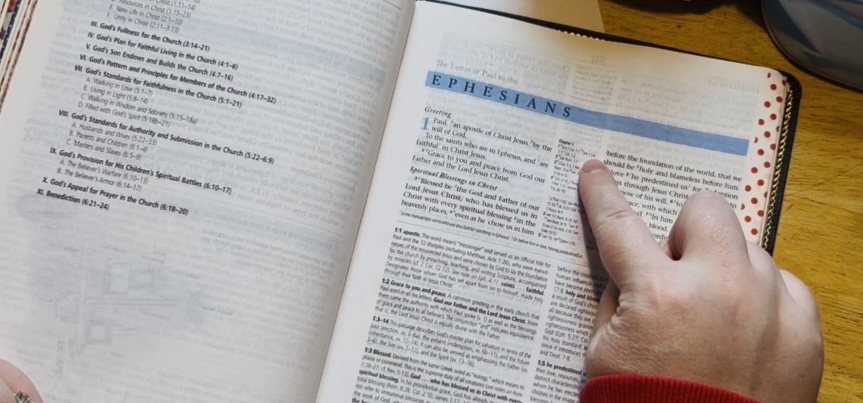
- If you have a study Bible you can find the cross references there.
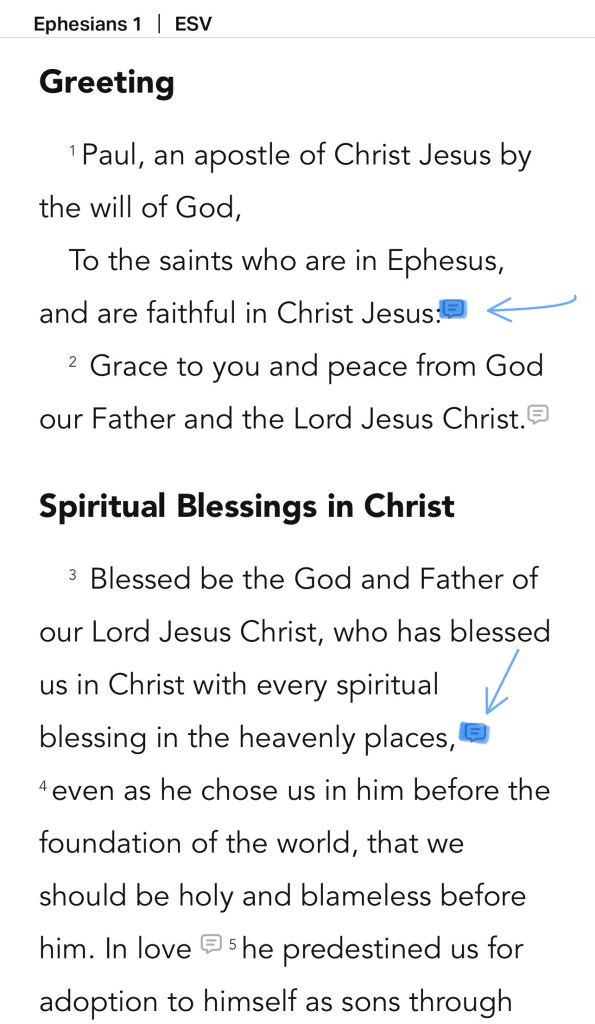
- You can also find cross references in the Bible app. I found that the ESV version on the Bible app has cross references and it’s free. There might be other translations on the Bible app that have cross references but the only one I have used for cross-references in the ESV.
#5 Read the verse in other translations of the Bible
The purpose of reading the text in different translations is to get a more rounded understanding of what the text means.
There is a “spectrum”, so to speak, of how different translations are translated. On one end you have “word for word” and on the other end you have “thought for thought”.
*I will be doing a video soon on my YouTube channel soon digging a tiny but deeper into different Bible translations.*
The main translation I reference is the ESV (English Standard Version).
Here is a list of the translations I reference often when I am studying the Bible and verse mapping. I feel these give me well rounded perspectives on the verse I am studying.
- NASB – New American Standard Bible
- CSB – Christian Standard Bible
- RSV – Revised standard version
- NIV – New International Version
- NLT – New Living Translation
I have all of these in My Versions on the Bible app that I can look at really quickly and conveniently.
#6 Paraphrase – write the verse in your own words
Once you’ve taken all these steps then now is a good time to write the verse in your won words. This will be helpful to see how well you understood the verse when you go on to the next step which is…
#7 Consult commentaries and/or study Bibles
I save this for the end because it’s always good to do the best you can to learn what you can on your own before you look at commentaries and study Bibles for help.
I find it really satisfying when I’ve done all the work and then consult a commentary and find they found they exact same thing I did.
Sometimes they will have a different conclusion than you and that’s ok. That doesn’t necessarily mean that you are wrong but it is a good idea to dig a little deeper and maybe even consult another commentary.
I have even had times when I have straight up disagreed with a certain commentary about a passage and found that another commentary came to the same conclusion as me. Not all commentaries will agree with each other and that is why it is good for us to make sure we are doing our own due diligence. We want to do our best to love God with OUR mind and not someone else’s mind. We want to know exactly why we came to a certain conclusion about a passage of scripture.
As Jen Wilkin says in her book “Women of the Word”, “[Commentaries] provide an indispensable service to the body of believers. But we must always keep in view that each of us individually is called to love God with our minds. This means that it is good for us to earnestly attempt interpretation on our own before we read the interpretations of others. And this means we must wait to consult commentaries, study Bibles, podcasts, blogs, and paraphrases for interpretative help until we have taken our best shot at interpreting on our own.”
If you are new to commentaries looking then I recommend The Bible Knowledge Commentary.
Conclude with these three questions:
After I’ve done all these steps I like to ask these three questions when all is said and done. Ultimately the Bible is a book about God and it’s always beneficial to see what a certain verse or passage teaches us about God and how that should change us.
*I learned to ask these three questions from Jen Wilkin’s Bible studies.*
- What does this verse teach me about God?
- What does this knowledge of God teach me about myself?
- How should this knowledge change me?

 Annie Dahlin